


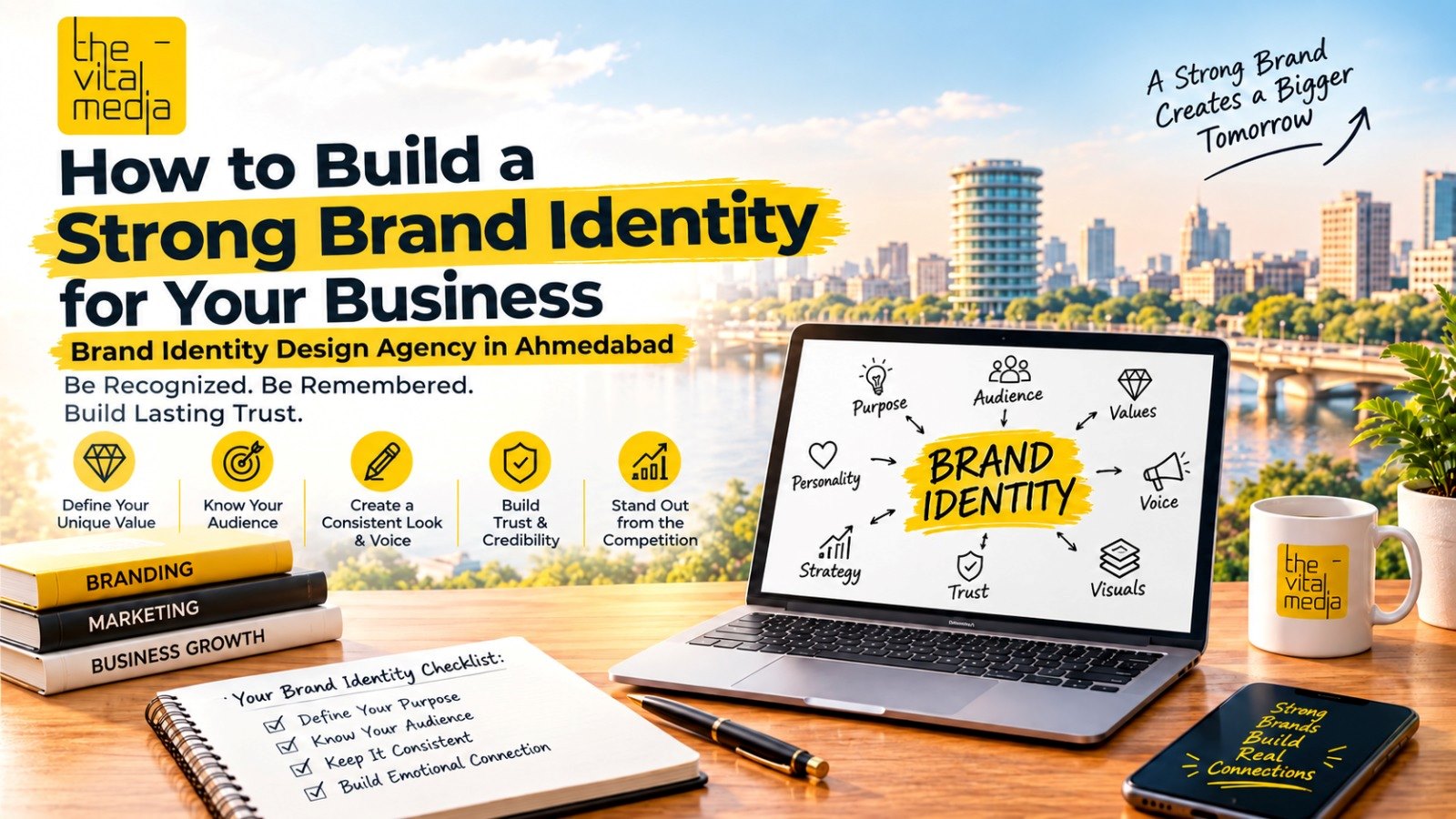
Brand Identity Design Agency Ahmedabad How to Build a Strong Brand Identity for Your Business
People often see a logo and call it branding.
It isn't.
A logo is one part of a much bigger system. Your brand identity includes the visual and verbal elements that help people recognize your business and understand what it represents.
Think about a company you recognize without reading its name. You may remember its colours, typography, packaging, imagery, tone or even the way its advertisements look. That recognition doesn't happen because of one logo. It comes from consistency.
For a growing business, building this consistency early can make marketing much easier.
If you are creating a new brand or updating an existing one, here's how to build a brand identity that can actually work in the real world.
What Is Brand Identity?
Brand identity is the collection of elements a business uses to present itself to its audience.
It can include:
- Logo
- Colour palette
- Typography
- Photography and imagery
- Graphic elements
- Packaging
- Website design
- Social media visuals
- Marketing materials
- Brand messaging
- Tone of voice
- Brand guidelines
These elements work together.
The purpose isn't simply to make the business look attractive. A well-planned identity should communicate something about the business and create a consistent experience wherever customers encounter it.
That is why brand identity design should start with understanding the business rather than opening a design software and immediately drawing a logo.
Start With Your Brand Strategy
Before deciding colours or fonts, decide what the brand stands for.
Ask some basic questions.
Who are your customers?
What problem does your business solve?
What makes your offer different?
Who are your competitors?
How do you want customers to describe your business?
What personality should the brand have?
A professional brand strategy gives these decisions a direction.
For example, a business selling premium interior products may want to communicate refinement and craftsmanship. A children's education brand may want to feel approachable, energetic and trustworthy.
The design choices should support that positioning.
Without this foundation, branding can become a collection of disconnected creative decisions.
Understand Your Target Audience
Your brand is not being created for you.
It is being created for the people you want to reach.
That doesn't mean you should ignore your own preferences. It means customer expectations need to be considered alongside them.
Look at how your audience makes decisions.
What language do they use?
What visual styles are common in your industry?
What do they expect from businesses like yours?
What might make them trust you?
What might make your business appear confusing or irrelevant?
This research can reveal opportunities to create a brand that feels familiar enough to understand but distinctive enough to remember.
Define Your Brand Positioning
Positioning answers a simple question:
Why should someone choose your business instead of another option?
Your answer should be specific.
Saying that your company provides "high-quality services" does not create much distinction because almost every business can say the same thing.
Instead, think about the particular value you bring.
Perhaps your business serves a specific audience. Maybe your process is different. Perhaps your expertise, product range, service model or customer experience gives you a meaningful point of difference.
This positioning should influence the rest of your identity.
Create a Memorable Logo
Once the strategic direction is clear, the visual identity can begin.
The logo is usually the most visible element.
A good logo should be recognizable, practical and appropriate for the business. It should also work in different sizes and formats.
Your logo may appear:
- On a website
- Inside a social media profile
- On packaging
- On business cards
- In advertisements
- On signage
- In presentations
- On mobile screens
That is why a logo that looks impressive in one large presentation may not necessarily be a practical business logo.
Good logo design considers how the mark will actually be used.
Choose a Colour System, Not Just a Favourite Colour
Colour influences recognition.
But choosing a colour because it looks nice is not enough.
Think about the personality and positioning you want the brand to communicate. Then build a colour system that can work across different applications.
A brand may need:
Primary colours for major brand elements.
Secondary colours for supporting communication.
Neutral colours for backgrounds and layouts.
The important part is consistency.
If your website uses one shade of blue, your social media uses another and your printed material uses something completely different, the visual identity starts losing cohesion.
Select Typography Carefully
Fonts have personality.
A typeface can make a brand feel modern, traditional, technical, elegant, playful or corporate.
But personality isn't the only consideration.
The typography needs to remain readable across different formats.
A font that looks good on a large poster may not work well for small website text.
A practical brand identity normally defines typography for different purposes, such as:
- Main headings
- Subheadings
- Body text
- Captions
- Supporting information
This makes future design work much easier.
Build a Consistent Visual Language
Your identity shouldn't stop at the logo.
Photography, illustrations, icons, shapes, patterns, layouts and other graphic elements can create a recognizable visual language.
Imagine seeing one of your social media posts without the logo.
Would someone still have a sense that it belongs to your brand?
That's the level of consistency worth aiming for.
The individual elements don't need to look identical every time. They simply need to follow a recognizable visual direction.
Don't Forget Brand Messaging
Brand identity isn't only visual.
The words your business uses also shape how people perceive it.
Think about your:
- Tagline
- Headlines
- Website copy
- Social media captions
- Advertising messages
- Product descriptions
- Sales communication
A professional identity should have a consistent brand voice.
A technology company might communicate in a direct and precise way. A lifestyle brand may use a more conversational style. A professional service company may need a more informative tone.
There is no universal "correct" tone.
The important thing is that the tone fits the brand and audience.
Make Your Identity Work Across Digital Channels
Your customers may discover your business online before they ever speak to you.
Your website, Google presence, Instagram account, LinkedIn page, advertisements and email communication all contribute to the brand experience.
This is where digital branding becomes important.
Your profile image, website graphics, social media templates, advertising creatives and content should follow the same visual direction.
When the same brand appears consistently across different digital touchpoints, recognition becomes easier.
Extend the Identity to Packaging
For product businesses, packaging is one of the most important brand touchpoints.
A customer may notice the package before they know anything about the company behind it.
Packaging needs to communicate the product while also looking like part of the wider brand.
This means colours, typography, imagery and graphic elements should connect with the core identity.
A strong packaging system can also make different products in the same range feel related.
If you are working with a packaging design company in Ahmedabad, share your brand guidelines early so packaging becomes an extension of the identity rather than a separate design exercise.
Create Brand Guidelines
A brand can lose consistency surprisingly quickly.
One designer changes the logo size.
Someone uses a slightly different colour.
Another team chooses a completely different font.
Over time, the identity starts looking fragmented.
Brand guidelines provide a common reference.
They can explain:
- Correct logo usage
- Minimum logo spacing
- Colour codes
- Typography
- Image style
- Graphic elements
- Layout principles
- Examples of correct and incorrect usage
The guideline document doesn't need to be unnecessarily complicated.
It simply needs to make the important rules clear enough for people to follow.
Test the Brand in Real Situations
Before finalizing your identity, see how it behaves outside the presentation.
Put it on a website.
Try it on a mobile screen.
Place it on packaging.
Create a social media post.
Put it on a business card.
Use it in an advertisement.
Look at it in black and white.
Reduce the logo to a small size.
This practical testing can reveal problems that aren't obvious when looking at a large design presentation.
A brand identity needs to work in everyday situations, not just in a portfolio mockup.
Keep the Brand Consistent as the Business Grows
Your business will change.
You may launch new products, add services, enter new markets or expand your team.
Your brand identity needs enough flexibility to grow with those changes.
This doesn't mean changing the identity every few months.
In fact, constant changes can make recognition harder.
Instead, build a system that allows new content and products to fit naturally into the existing brand.
That is one of the reasons a properly developed visual identity system is more useful than simply having a logo file.
When Should You Consider Professional Branding Services?
You don't always need a branding agency.
If you are creating a small personal project, a simple visual identity may be enough.
Professional branding becomes more valuable when the brand has more complexity.
You may need expert help if:
- You are launching a serious new business.
- Your current identity looks outdated.
- Your branding changes from platform to platform.
- Customers struggle to understand what your business represents.
- You are entering a new market.
- You are launching several products.
- Your business is going through a rebrand.
- Multiple teams or vendors need to use the same identity.
In these situations, a branding agency in Ahmedabad can bring strategy and design together rather than treating each creative requirement separately.
Common Brand Identity Mistakes to Avoid
Designing Before Defining the Strategy
Starting with colours and logos before deciding the brand direction can lead to inconsistent decisions later.
Copying a Competitor
Your competitors can provide useful market information. Their branding should not become your template.
Using Too Many Visual Elements
More colours, fonts and graphic elements don't automatically create a stronger identity.
Ignoring the Customer
A brand should reflect the business while remaining relevant to the audience it serves.
Changing the Identity Too Often
Recognition takes time. Constant visual changes can work against it.
Forgetting About Practical Usage
A logo needs to work on a small screen just as well as it works on a large presentation.
How The Vital Media Helps Build Brand Identity
At The Vital Media, we approach branding as a combination of strategy and creative development.
Depending on the requirement, our branding services in Ahmedabad can include brand strategy, positioning, logo design, visual identity, corporate branding, digital branding, packaging, personal branding, rebranding and brand guidelines.
The process starts with understanding the business and the people it needs to reach.
From there, the visual direction is developed around the brand's positioning and practical requirements.
The objective is not to create another attractive logo that exists only in a presentation.
It is to build an identity that can be used consistently across the places where customers actually interact with the business.
If you are developing a new brand or considering a brand refresh, explore our Branding Agency in Ahmedabad services to see how the complete branding process can support your business.
Final Thoughts
A strong brand identity doesn't happen because someone picked the right font or created a clever logo.
It comes from many small decisions working together.
Strategy.
Positioning.
Visual identity.
Messaging.
Consistency.
Practical application.
When these pieces support one another, your business becomes easier to recognize and easier to understand.
And that is ultimately what a brand identity should do.
It should give your business a clear and consistent way to show up wherever your customers find you.
Frequently Asked Questions
What is included in a brand identity?
A brand identity can include a logo, colour palette, typography, imagery, graphic elements, brand messaging, packaging, digital assets and brand guidelines. The exact elements depend on the business and its requirements.
How is brand identity different from branding?
Brand identity refers to the elements a business creates and uses to present itself. Branding is the broader process of shaping how the business is positioned, communicated and perceived.
Why is brand identity important for a business?
A consistent identity helps customers recognize the business across different touchpoints. It can also make communication more cohesive and help a company establish a clear market presence.
How long does it take to create a brand identity?
The timeline depends on the scope. A simple identity project can be relatively focused, while a complete branding project involving research, strategy, identity design, packaging and guidelines requires more time.
Can an existing business change its brand identity?
Yes. An established business can refresh or completely rework its identity depending on its goals. The right approach depends on what is working in the current brand and what needs to change.
Should a startup invest in brand identity?
A startup does not necessarily need an elaborate branding system on day one. However, establishing a clear identity early can make future marketing and communication more consistent as the business grows.
Can a branding agency help with digital branding?
Yes. Digital branding can cover website visuals, social media identity, digital creatives, advertising assets and other online customer touchpoints.

Great marketing isn’t about noise, it’s about measurable growth built on trust.