


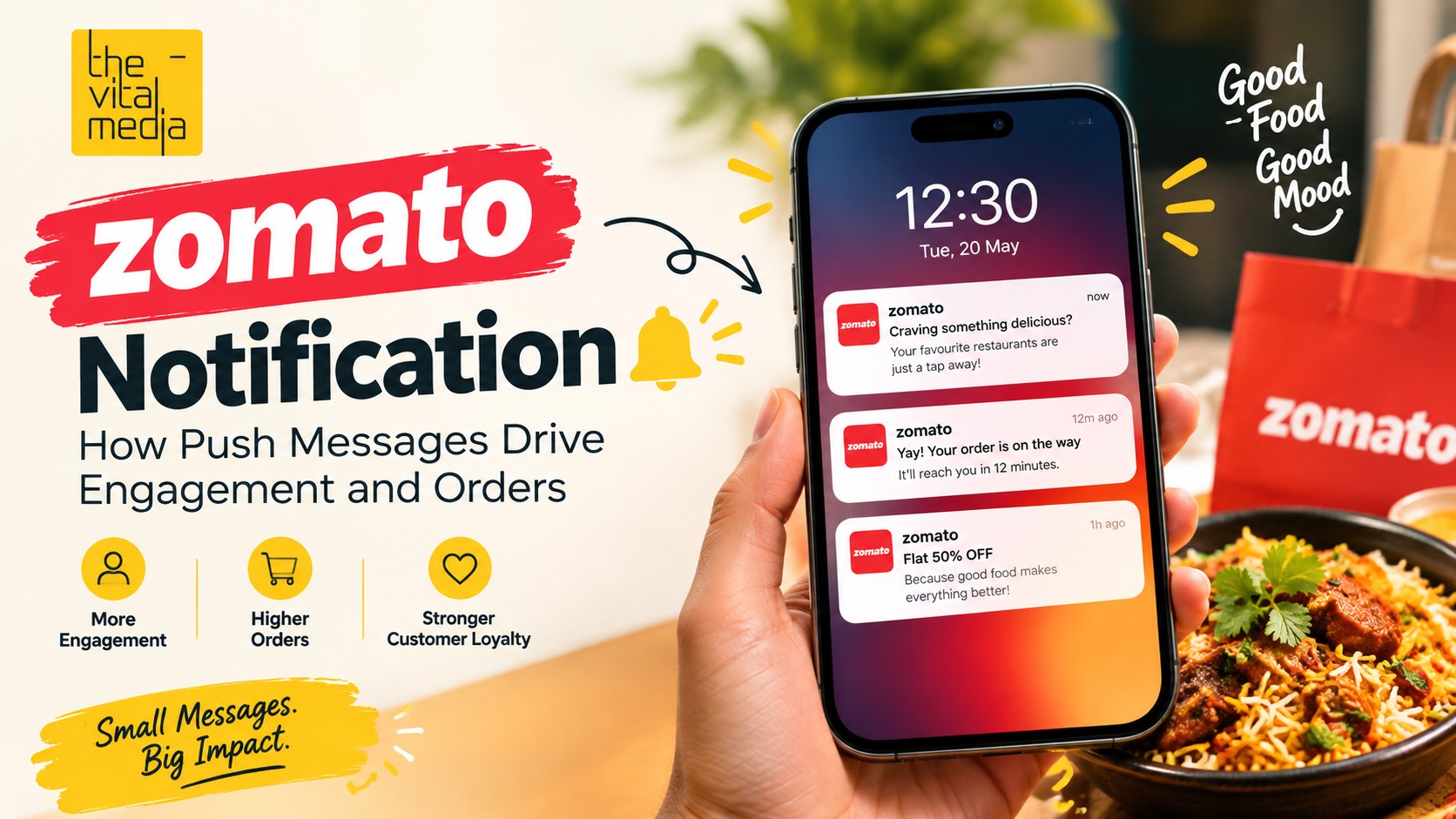
Zomato Notification: How Push Messages Drive Engagement and Orders
You are busy.
Then your phone buzzes.
You look at the screen. It is a Zomato notification.
Sometimes it is about an order. Sometimes it is an offer. And sometimes it is just a clever little message that makes you smile.
That is the interesting part.
A notification takes only a few seconds to read. Yet a good one can make you open an app, browse a restaurant, remember a craving or place an order.
Zomato has made this tiny space on a phone screen an important part of its communication. Instead of treating every notification as a boring system alert, the brand has used short-form copy, timing, relevance and personality to make its messages more noticeable.
But there is more to it than writing a funny sentence.
The real story is about when the message appears, who receives it, what it says and what happens after the user taps it.
Let's look at how that works.
What Is a Zomato Notification?
A Zomato notification is a message sent through the Zomato app to communicate with a user.
Some notifications are purely functional.
For example, a user may receive information about an order, delivery status or another activity related to the service.
Others are designed to bring the user back to the app.
They may highlight a restaurant, food option, offer or recommendation.
Then there are notifications that are clearly part of the brand's marketing communication.
This creates an important difference.
But there is more to it than writing a funny sentence.
A notification doesn't always have to say:
“Buy this.”
It can simply give the user a reason to look.
That reason could be relevance, curiosity, convenience, timing or even a little humor.
And that is where Zomato notification marketing becomes interesting.
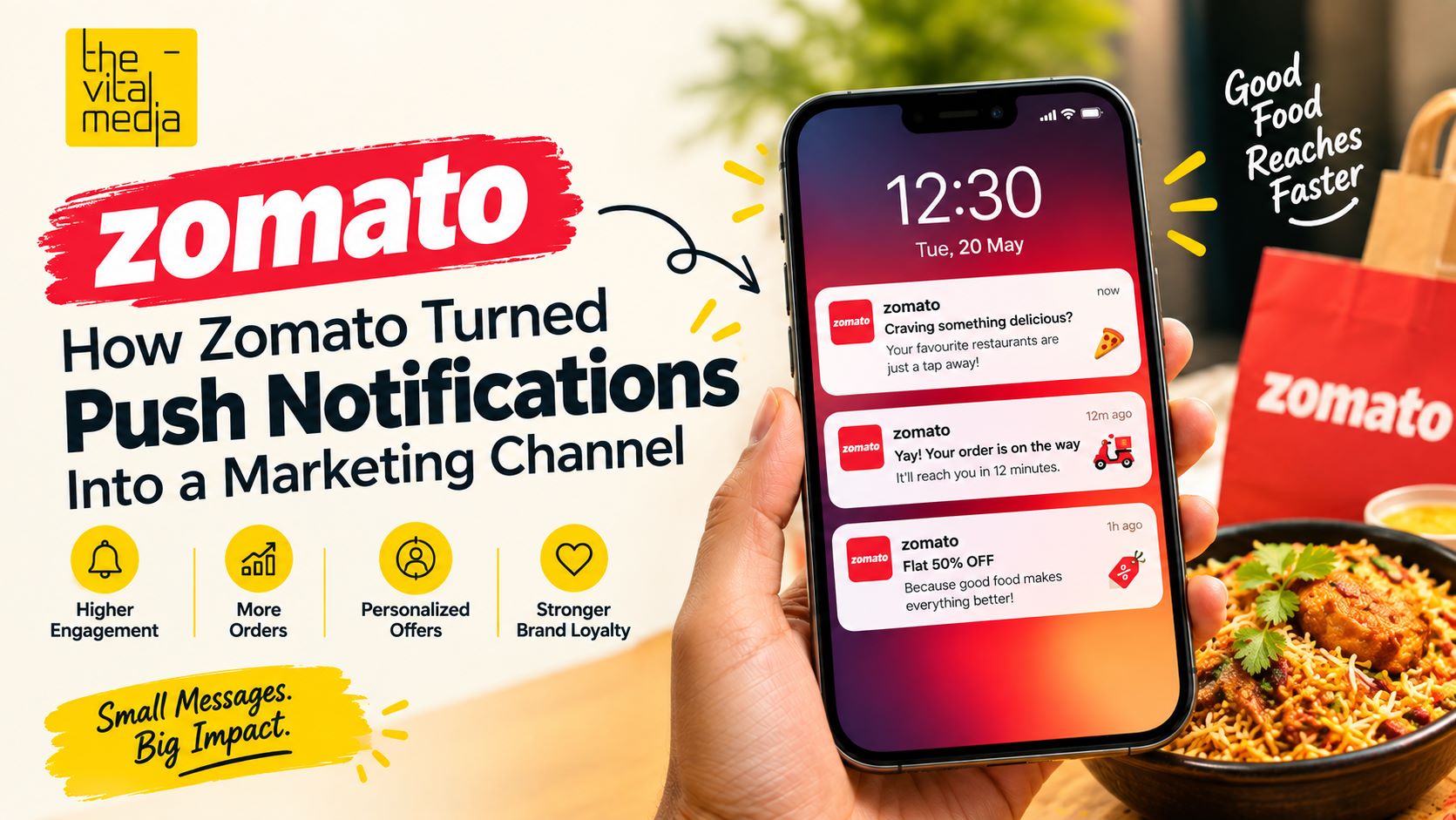
How Zomato Turned Push Notifications Into a Marketing Channel
Most people don't open an app because a company wants them to.
They open it because they have a reason.
Maybe they are hungry.
Maybe they want something specific.
Maybe they have been thinking about ordering since afternoon.
Maybe they simply saw something interesting.
A good Zomato push notification tries to connect with that moment.
Instead of looking at a notification as a standalone advertisement, think of it as the beginning of a small journey:
The notification doesn't guarantee an order.
But it can create the opportunity for one.
This is why push notifications have become an important part of modern food delivery app marketing.
The Zomato Notification Strategy: It Starts With Relevance
Imagine receiving the same message every evening.
“Order food now. Get exciting offers.”
The first time, perhaps you notice it.
After a few days?
You probably swipe it away.
This is the problem with generic notification marketing.
People don't want more messages.
They want more relevant messages.
A strong notification strategy therefore starts with understanding the user.
What do they usually order?
When do they use the app?
What restaurants or cuisines interest them?
Have they recently searched for something?
Are they an active customer or someone who hasn't opened the app for a while?
The exact systems and algorithms behind Zomato's notifications are not publicly available in full. But its publicly visible communication and marketing behavior show why relevance, context and timing are central themes when analyzing the strategy.
And that leads to the first major lesson:
Personalization isn't about adding someone's name to a message.
It is about making the message make sense for that person.
Why Zomato Push Notifications Don't Always Feel Like Ads
This is where the writing matters.
Compare these two messages:

Get 20% off on food orders today.
nowand
Still thinking about dinner?
nowThe first one is clearly promotional.
The second one starts a conversation.
That difference can be surprisingly powerful.
Zomato's communication style has become closely associated with short, conversational and playful copy. Marketing analyses of the brand frequently point to its use of humor, context and recognizable brand personality.
The lesson isn't that every company should become funny.
It is simpler than that.
Your notification should sound like your brand.
If your brand is serious, sound serious.
If your brand is playful, let that personality come through.
Consistency matters.
Types of Zomato App Notifications
Not every notification has the same purpose.
Understanding the different types makes the overall Zomato notification strategy easier to understand.
Order Notifications
These are the practical ones.
- Order confirmation.
- Restaurant acceptance.
- Delivery updates.
- Arrival information.
Their purpose is simple: keep the customer informed.
There is no need for clever copy here if the information itself is important.
Clarity comes first.
Promotional Notifications
These notifications introduce an offer or another commercial reason to open the app.
The challenge is frequency.
Send too many promotions and the user stops paying attention.
A promotion becomes more useful when it has some context behind it.
A relevant offer can feel useful.
An irrelevant offer feels like another interruption.
Personalized Notifications
This is where things become more interesting.
Suppose someone regularly orders a particular type of food.
A notification related to that preference is naturally more relevant than a completely random recommendation.
This is the role of personalized notifications.
The objective is not simply to make a message look personal.
It is to reduce the distance between:
“Here is an advertisement.”
and
“This might actually be useful to you.”
Re-Engagement Notifications
Not every customer behaves the same way.
Some users order regularly.
Some open the app occasionally.
Some disappear for weeks.
A re-engagement notification tries to bring an inactive or less-active user back into the experience.
This is important because customer acquisition is only one part of growth.
Keeping existing users engaged matters too.
Context-Based Notifications
Food is strongly connected to everyday moments.
A message can become more relevant when it connects with something already happening around the customer.
That is the basic idea behind contextual marketing.
The message doesn't have to interrupt the moment.
It can become part of it.
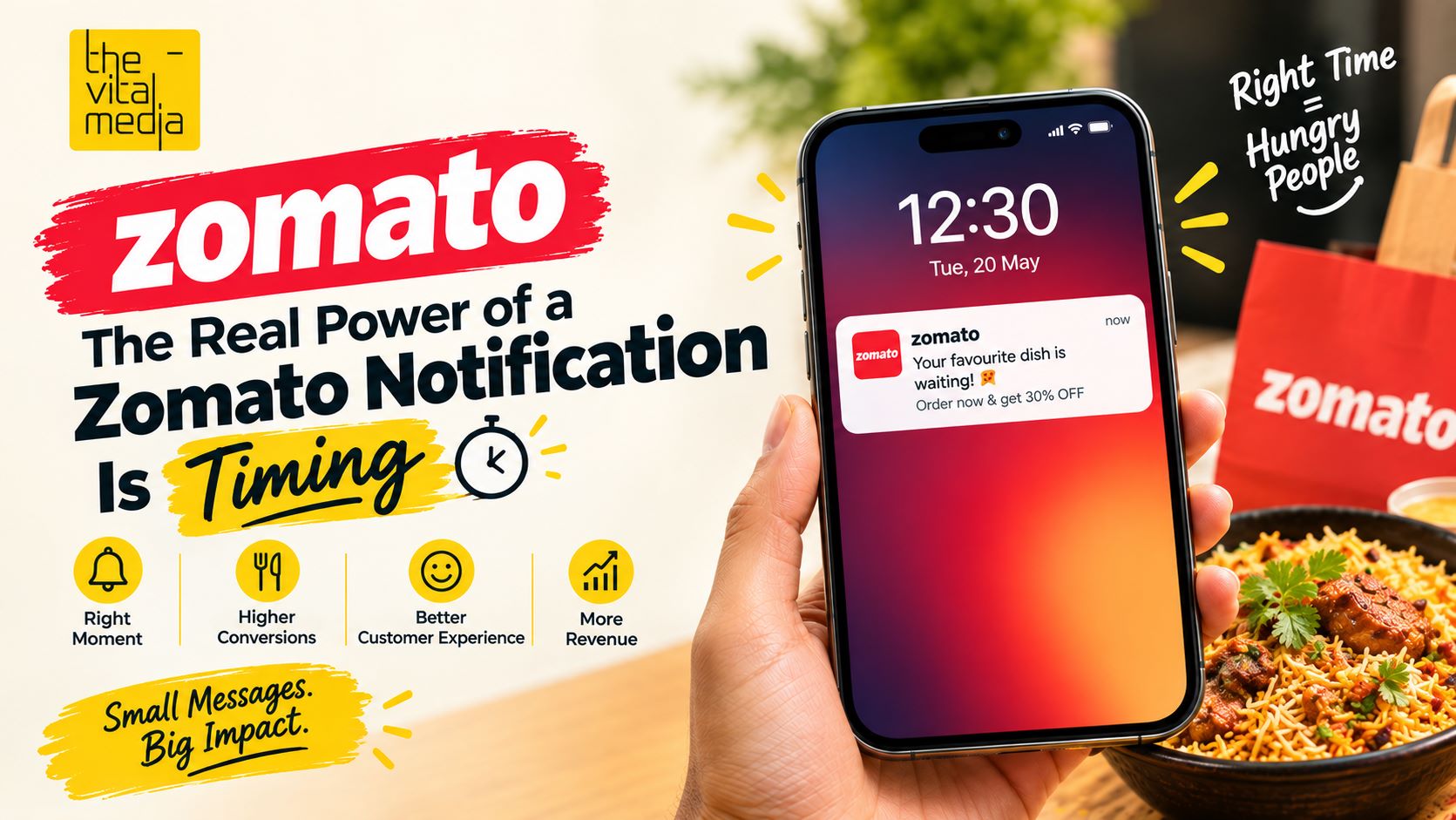
The Real Power of a Zomato Notification Is Timing
Imagine receiving a dinner-related notification at 11:30 in the morning.
You might ignore it.
Now imagine seeing a relevant message around the time you're actually deciding what to eat.
Same phone.
Same app.
Different moment.
Different possibility.
Timing can change how a message is perceived.
That is why push notification marketing is not simply about creating good copy.
It is also about deciding:
Who should receive it?
When should they receive it?
Why now?
Current analyses of Zomato's notification approach repeatedly highlight meal-time windows, contextual triggers and user behavior as important parts of the strategy.
The broader marketing lesson is useful for any mobile app:
A good message at the wrong time can still be a bad message.
Zomato Notification Examples: Look at the Structure, Not Just the Joke
There is a temptation when studying Zomato to collect funny notification screenshots.
That's useful for inspiration.
But marketers should go one step further.
Look at the structure.
For example, imagine a notification built around a rainy evening:
Rain outside. Something warm inside?
nowWhat makes it work?
Not the exact sentence.
It connects:
Weather → Mood → Food → Action
Now imagine a message based on user behavior:
Ordered this last Friday. Thinking about a repeat?
nowThe structure becomes:
Past behavior → Familiarity → Suggestion
This is how you should study Zomato notification examples.
Don't copy the wording.
Understand the thinking behind it.
The Psychology Behind Zomato Notification Marketing
A phone notification competes with dozens of other messages.
So why would someone notice one?
There are several possible reasons.
Curiosity
A message can create a small information gap.
You want to know what it means.
That can encourage an app open.
But curiosity works best when there is something meaningful behind the click.
Relevance
This is probably the biggest factor.
A message connected to someone's current situation has a better chance of getting attention than something completely random.
Relevance can come from behavior, timing, location, preferences or context.
Humor
A funny message can interrupt the routine.
People expect advertisements to sell.
They don't always expect them to make them smile.
That surprise can make a brand more memorable.
Zomato's wider communication has built a recognizable association with witty and culturally aware messaging.
Urgency
“Available for a limited time.”
“Ends tonight.”
“Last chance.”
Urgency can encourage action when there is a genuine reason for it.
But there is a catch.
If every notification sounds urgent, nothing feels urgent anymore.
Familiarity
People become familiar with brands that communicate consistently.
Over time, the tone itself becomes recognizable.
You may not even need to see the logo.
The writing gives the brand away.
That's powerful branding.
Zomato Customer Engagement Goes Beyond Getting a Click
It is easy to measure a notification by asking:
Did the user open it?
But the bigger picture is much wider.
A notification can contribute to:
- App re-engagement
- Food discovery
- Repeat ordering
- Customer familiarity
- Brand recall
- Promotional response
- Long-term retention
That doesn't mean every notification produces an order.
It shouldn't.
- Some messages are functional.
- Some create awareness.
- Some bring back inactive users.
- Some simply maintain the relationship.
This is why Zomato customer engagement should be viewed as a long-term process rather than a single click.
Where Push Notifications Fit Into Zomato's Marketing Strategy
A notification doesn't work in isolation.
It sits inside a much larger Zomato marketing strategy.
Think about the different touchpoints a customer may experience:
Social Media
Creates attention.
Content
Builds conversation.
Advertising
Creates reach.
App Experience
Creates interaction.
Push Notifications
Bring users back.
Offers
Create commercial motivation.
Customer Experience
Influences whether they return.
Each channel has a different job.
The interesting part is how these channels can support one another.
That is what makes a digital marketing strategy stronger than simply running individual campaigns.
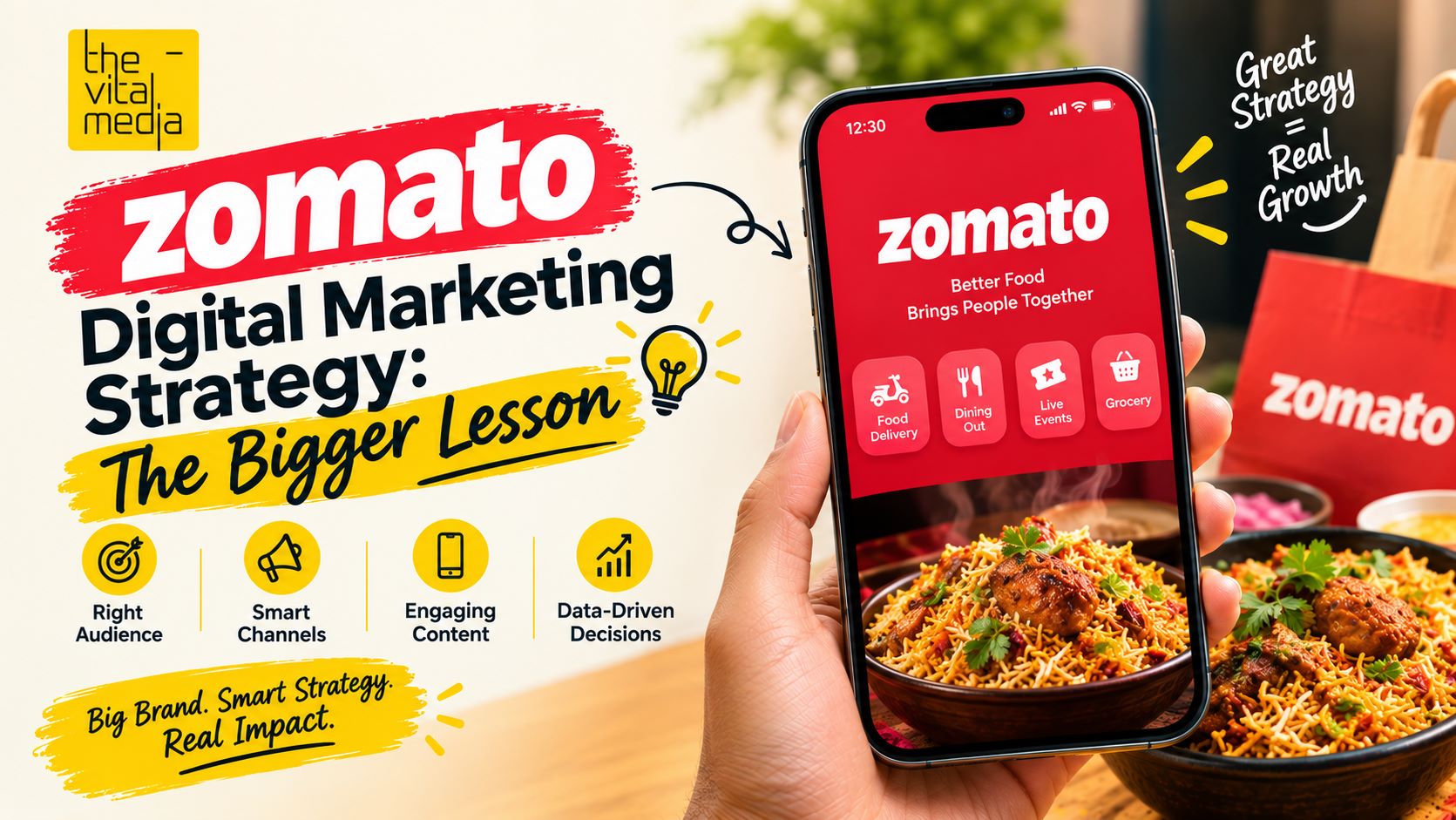
Zomato Digital Marketing Strategy: The Bigger Lesson
The biggest lesson isn't:
“Write funny notifications.”
That's too shallow.
The bigger lesson is:
Make communication feel relevant to the person receiving it.
That can happen through data.
It can happen through timing.
It can happen through creativity.
It can happen through culture.
And it can happen through a strong brand voice.
Zomato's broader digital presence is often associated with moment marketing, meme-led communication and quick reactions to cultural conversations.
But speed alone isn't enough.
A brand has to know when a moment actually makes sense for it.
What Businesses Can Learn From Zomato's Mobile Marketing Strategy
You don't need to be a food delivery company to apply these principles.
An ecommerce app can remind customers about products they viewed.
A travel app can communicate around upcoming trips.
A fitness app can send relevant workout reminders.
A fashion app can highlight products based on browsing behavior.
A SaaS product can remind users about unfinished tasks.
The industry changes.
The principle doesn't.
Know the user.
Understand the moment.
Give the message a purpose.
Keep the copy natural.
Don't over-message.
Measure what happens next.
That's the foundation of a useful notification marketing strategy.
How to Create a Zomato-Inspired Notification Strategy Without Copying Zomato
This is an important distinction.
You shouldn't copy another company's personality.
You should understand the principles behind it.
Start with your audience.
Divide customers according to meaningful behavior.
Identify useful triggers.
Choose the right timing.
Create a message that sounds like your brand.
Then test it.
For example:
Step 1:
Identify the user
Who is receiving the message?
Step 2:
Identify the trigger
Why are you contacting them now?
Step 3:
Identify the value
What does the user get from opening the message?
Step 4:
Write naturally
Remove unnecessary marketing language.
Step 5:
Choose the right timing
Don't send simply because the campaign calendar says so.
Step 6:
Measure the outcome
Look beyond opens.
Consider clicks, conversions, repeat actions and opt-outs.
Step 7:
Improve
Keep what works.
Change what doesn't.
That is a sustainable mobile marketing strategy.
The Difference Between a Notification and a Good Notification
Anyone can send a notification.
The difficult part is giving someone a reason to care.
A weak notification says:
A stronger one understands the situation first.
Maybe the customer has been browsing.
Maybe it is their usual ordering time.
Maybe something relevant has changed.
Maybe the message simply makes them curious.
The difference is not always the offer.
Sometimes it is the context.
Final Thoughts
A Zomato notification may occupy only a tiny rectangle on a smartphone screen.
But behind that small message can sit audience data, timing, segmentation, creative thinking, brand voice and a clear business objective.
That's why Zomato's push communication is worth studying.
Not because every business should copy its jokes.
Not because every notification needs a discount.
And certainly not because sending more notifications automatically means getting more orders.
The better lesson is much simpler.
Say something relevant.
Say it at the right moment.
Make it sound human.
And give the customer a reason to continue the conversation.
That is where push notification marketing moves from interruption to engagement.
Frequently Asked Questions About Zomato Notification
What is a Zomato notification?
A Zomato notification is a message delivered through the Zomato app. It can provide order updates, promotions, recommendations, reminders and other user-related information.
What is Zomato notification marketing?
Zomato notification marketing refers to using app-based push messages as part of customer communication and marketing. The strategy can involve relevance, timing, personalization, segmentation and brand voice.
Why are Zomato push notifications effective?
Their effectiveness can be understood through several factors, including concise copy, contextual relevance, recognizable brand personality, personalization and timing.
What are Zomato app notifications used for?
They can be used for functional updates such as order information as well as promotional, personalized, re-engagement and discovery-focused communication.
How does personalization help notification marketing?
Personalization can make a message more relevant by considering information such as user behavior, preferences and previous interactions. Relevant communication can be more useful than generic messages.
What can businesses learn from Zomato notifications?
Businesses can learn to focus on relevance, timing, audience segmentation, clear messaging and consistent brand personality instead of sending the same promotional message to everyone.
Should every business copy Zomato's notification style?
No. The useful lesson is the strategy behind the communication, not the exact jokes, phrases or personality. Each business should develop a notification style that fits its own audience and brand.
Conclusion
At The Vital Media, we help businesses build marketing strategies that are practical, data-driven, and focused on measurable growth. From digital marketing and social media to performance campaigns and branding, we combine creative thinking with insights that help your brand make better marketing decisions.
Every campaign is planned with clear objectives and measurable outcomes, so your marketing efforts contribute to real business growth.
Get in touch with The Vital Media and let’s build a strategy that works for your brand.

Great marketing isn’t about noise, it’s about measurable growth built on trust.